
Finding a ceramide supplier is easy. Qualifying a grade that will survive scale-up is harder. The purchasing decision is not only about Ceramide NP price or the number shown on a sales sheet. Ceramides are highly lipophilic, and their behavior depends on the carrier system, the other barrier lipids, the order of addition, and the final emulsion.
For teams developing barrier creams, lotions, or milky serums, a ready-to-use liposomal ceramide raw material can remove part of the pre-dispersion work. It does not remove the need to qualify the dispersion itself. This guide uses ZLEY PKG201 as a concrete example and shows what a formulator or buyer should verify before approving a sample.
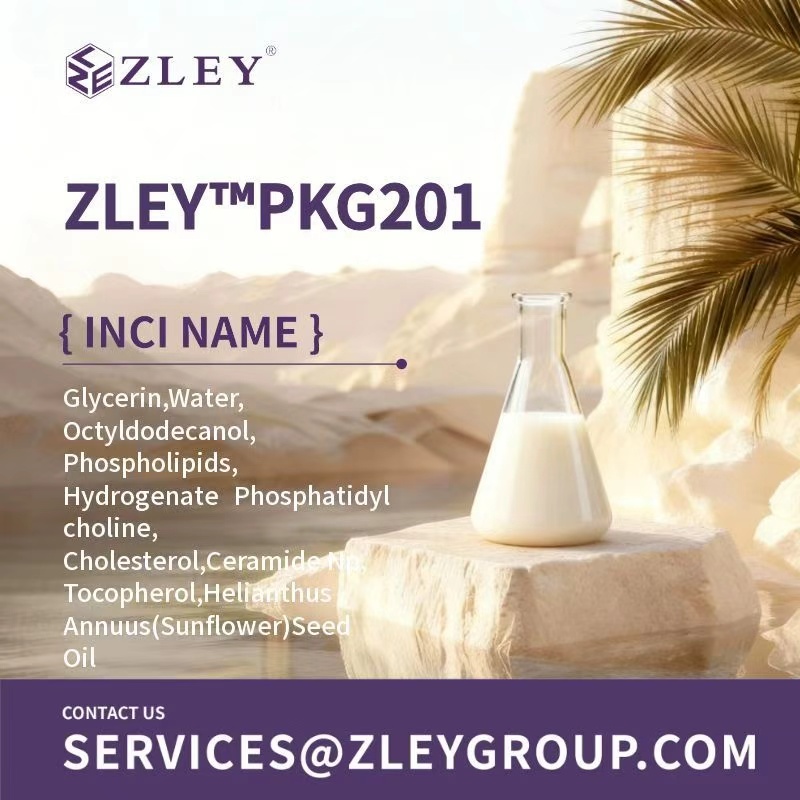
PKG201 at a glance
| Buyer question | Published grade information |
|---|---|
| Commercial form | Milky-white viscous liquid; a multi-component ceramide dispersion rather than a neat ceramide powder |
| Published composition | Glycerin, water, octyldodecanol, phospholipids, hydrogenated phosphatidylcholine, cholesterol, Ceramide NP, tocopherol, and sunflower seed oil |
| Supplier starting use level | 1-5% of the finished dispersion |
| Handling | Dispersible in water; the product page also lists compatibility with glycols and alcohols |
| Best first applications | Opaque or milky creams, lotions, and emulsion serums positioned for moisturization and barrier support |
| Critical item not stated publicly | Ceramide assay, particle-size specification, pH window, preservative system, and validated process-temperature limit |
Важно: the 1-5% figure is the recommended addition level for the complete dispersion. It is not a claim that the final formula contains 1-5% pure Ceramide NP. Ask for the current signed TDS and composition statement before calculating an active-dose claim or finalizing an ingredient list.
Why the delivery system matters more than a headline percentage
A ceramide does not work in isolation from its vehicle. In a human barrier-recovery study, an emulsion combining ceramides with phytosphingosine, cholesterol, and a free fatty acid accelerated recovery after surfactant damage more effectively than the tested ceramide-only mixture. The practical lesson is formulation-specific: the organization and ratio of barrier lipids matter, not just whether “ceramide” appears on the label.
A separate 2021 formulation study developed stable liposomes containing ceramides 3 and 6 together with cholesterol and stearic acid. The researchers evaluated particle size and polydispersity rather than accepting “liposomal” as a self-proving claim. That is the right procurement mindset for any ceramide liposome system.
These publications explain useful formulation principles. They are not performance data for PKG201, and they should not be presented as clinical proof for a finished product made with this grade.
A practical first-lab protocol
- Build and homogenize the base first. Complete the emulsion and its primary high-shear step before introducing the ceramide dispersion.
- Add during cool-down. For an initial screen, add below 40 C under moderate sweep unless the current supplier TDS gives a validated alternative. Treat this as a conservative development starting point, not a guaranteed manufacturing limit.
- Pre-dilute only when needed. If direct addition creates local streaks or lumps, pre-disperse PKG201 in a small portion of the cool aqueous phase or a compatible glycol from the formula.
- Run a 1%, 3%, and 5% ladder. Keep the rest of the vehicle constant. This separates a genuine dose response from changes caused by oil phase, emulsifier, or humectant adjustments.
- Avoid automatic post-addition high shear. If high shear is required for appearance, compare particle size or at least microscopy before and after processing. A smooth-looking batch does not prove that the original vesicle structure remains intact.
- Record 24- and 48-hour values. Check pH, viscosity, color, odor, uniformity, and centrifuge behavior after the system has equilibrated.
The main compatibility risks are high electrolyte load, aggressive surfactants, high alcohol content, an extreme pH, and repeated heat exposure. A small design-of-experiments screen is more useful than one “successful” bench batch. Include the blank vehicle and compare it with each PKG201 level.
Where this grade fits, and where it does not
Good starting projects
- Barrier-support face creams and body lotions
- Milky serums and light emulsions for dry or sensitive-feeling skin
- After-sun moisturizers and formulas designed to support skin comfort
- Multi-active systems where easier handling is more important than a single-INCI raw material
Poor starting projects
- Water-clear gels, because the milky dispersion can introduce haze
- Anhydrous oils or balms, because the commercial grade contains water and glycerin
- High-alcohol formats without a dedicated compatibility study
- Projects that require a high-assay, single-component Ceramide NP powder
- Finished-product clinical claims that are not supported by testing on the final formula
For a project that needs a water-soluble stress-protection active rather than a barrier-lipid dispersion, a material such as ZLEY Ectoin performs a different formulation job. It should not be treated as a direct substitute for ceramide.
Supplier qualification before the purchase order
A serious ceramide supplier should be able to answer the following questions with documents, not only marketing copy:
- Identity: What is the exact current INCI list, and does it match the label statement for every target market?
- Active content: What is the Ceramide NP assay in the supplied dispersion, what method is used, and what is the release range?
- Delivery-system control: Is particle size a release specification? If so, request the mean size, distribution method, PDI limit, and data from at least three lots.
- Microbiology: What are the microbial limits and preservative components? A water-containing raw material must be included in the finished formula’s challenge-test strategy.
- Стабильность: What shelf life, storage temperature, light protection, and freeze-thaw limits are supported?
- Traceability: Request a batch COA, SDS, country of origin, manufacturing-flow summary, allergen statement, and relevant GMO or animal-origin declarations.
- Regulatory status: Confirm market-specific inventory status and claims language. The CIR safety assessment covers multiple cosmetic ceramides under reported practices of use, but it is not a substitute for regional compliance review of the complete grade and finished product.
Stability work that should happen before scale-up
At minimum, compare the blank and selected PKG201 prototypes at 4 C, room temperature, and 40-45 C, plus freeze-thaw and centrifuge screens. Track pH, viscosity, color, odor, separation, and microscopy. If the liposomal structure is part of the technical or marketing rationale, add particle-size and PDI measurements at initial, intermediate, and final checkpoints. Complete preservative efficacy testing on the final formula; supplier microbiological limits do not predict finished-product protection.
Agree the incoming specification before the pilot order. Appearance, odor, pH, active assay, microbial limits, and any particle-size criterion should have written acceptance ranges. A COA with only “conforms” is weak if the parameter is important to formulation performance.
Bottom line for formulation buyers
PKG201 is a credible sample candidate when the project needs an easy-to-handle, water-dispersible ceramide complex for an opaque emulsion. It is probably the wrong starting material for a clear gel, an anhydrous product, or a brief that requires a single high-assay ceramide powder. Start with the 1%, 3%, and 5% ladder, protect the dispersion from unnecessary post-addition shear, and do not approve the purchase order until the active assay and delivery-system controls are documented.
Review the PKG201 product page, this skin barrier technical overview, and a related example of cyclodextrin molecular encapsulation when comparing delivery formats.
Buyer FAQ
Is 1-5% the pure Ceramide NP dosage?
No. It is the supplier’s recommended use level for the complete PKG201 dispersion. Calculate pure-ceramide exposure only from a documented assay.
Can PKG201 be used in a clear serum?
It is not the first choice. The raw material is milky-white and may create haze. Use a clarity test at the intended dose before promising a transparent appearance.
Does a liposomal raw material guarantee better finished-product efficacy?
No. Delivery-system integrity, dose, base composition, processing, packaging, and use conditions all matter. Support any superiority claim with data on the final formula.